

*Please scroll down for the English version.
TDLI RESEARCH ACHIEVEMENTS
近日,一项关于“事件视界望远镜(EHT)拍摄的黑洞图像可以成为探测暗物质的有力工具”的最新研究发表于《物理评论快报》(Physical Review Letters),并入选“编辑推荐”。该论文作者按字母顺序署名。共同通讯作者包括陈一帆(即将以青年学者身份加入李政道研究所)和Yosuke Mizuno(李政道研究所长聘学者),以及安徽大学丁然副教授、北京大学舒菁教授和其博士生刘雨鑫、于海跃、曾彦杰。


揭示暗物质的微观本质是当代物理学最大的挑战之一,也是李政道研究所的重要研究目标。暗物质研究的一个关键途径是间接探测,即通过观测其湮灭或衰变产生的标准模型粒子(如光子或中微子)的天体物理信号来寻找线索。
在超大质量黑洞附近,极端的引力能够将暗物质聚集形成高密度的“尖峰结构”,其能量密度比太阳系邻域高出多个数量级。这大幅提高了暗物质湮灭的概率,使这些区域成为观测的天然优势场所。
EHT对M87*超大质量黑洞的成像展示了一个被明亮光子环包围的暗“阴影”。研究发现,其中最暗的“内阴影”区域由黑洞赤道平面上的外视界的引力透镜轮廓构成, 对暗物质湮灭产生的辐射尤为敏感。与普通等离子体通常被喷流排出不同,暗物质湮灭能够在阴影区持续注入电子和正电子对,它们在磁场背景下通过同步辐射发光,从而点亮原本漆黑的区域,如图1中的右图所示。
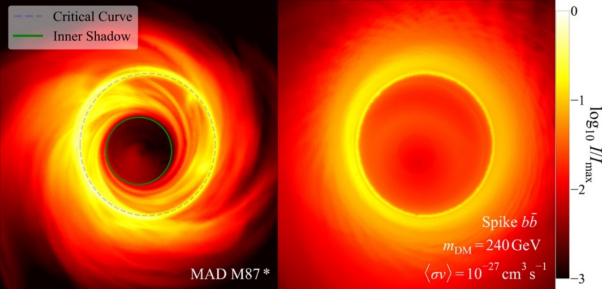
图1: 对超大质量黑洞附近同步辐射的模拟:左图为天文背景中的等离子体辐射;右图为一个暗物质湮灭产生正负电子对的辐射图。
为确保结果的可靠性,研究团队建立了迄今最全面的理论框架,用于模拟电子–正电子同时在黑洞强引力和磁场环境下的传播。该框架基于与现有EHT观测数据相符的广义相对论磁流体动力学模拟。结果显示,这一方法排除了大量此前未被探索的暗物质模型,并确立了黑洞成像作为基础物理前沿研究的新方向。展望未来,下一代EHT的动态范围的提升,将使其能够探测更暗的阴影区域,进一步增强对暗物质的灵敏度。
该工作得到了国家自然科学基金 (Nos. 12273022, 12025507, 12150015, 12450006),科技部重点研发计划重点专项 (Nos. 2020YFC2201501, 2021YFC2203004, 2021YFC2203100, 2023YFE0101200)和上海市科学技术委员会2022年度外国专家基础研究项目 (No. 22JC1410600)的资助。
https://doi.org/10.1103/yxqg-363n
文稿 | 陈一帆
编辑 | 孟闻卓
责任编辑 | 李姝姝
Dark Matter Can Illuminate Black Hole Shadows
TDLI RESEARCH ACHIEVEMENTS
A new study published in Physical Review Letters, selected as an Editors’ Suggestion, demonstrates that black hole images from the Event Horizon Telescope (EHT) can serve as powerful probes of dark matter. This work is authored in alphabetical order and includes corresponding authors Yifan Chen, who will soon join Tsung-Dao Lee Institute as a tenure-track fellow, and Yosuke Mizuno, a tenured fellow of TDLI, as well as Ran Ding from Anhui University, Jing Shu from Peking University, and PhD students Yuxin Liu, Haiyue Yu, and Yanjie Zeng.


Unveiling the microscopic nature of dark matter is one of the biggest challenges in modern physics, and a key research goal at the Tsung-Dao Lee Institute. One important approach is indirect detection, which searches for astrophysical signals from dark matter annihilation or decay into Standard Model particles such as photons or neutrinos.
Near supermassive black holes, extreme gravity can concentrate dark matter into dense “spikes,” with energy densities orders of magnitude higher than those in the solar neighborhood. This greatly enhances annihilation rates, making these regions uniquely promising for observation.
The EHT’s images of the supermassive black hole M87* reveal a dark “shadow” encircled by a bright photon ring. The study shows that the faintest region of this shadow, the “inner shadow,” shaped by light bending near the horizon, is especially sensitive to radiation from dark matter annihilation. Unlike ordinary plasma, typically expelled by jets, dark matter annihilation continuously injects electron–positron pairs, which radiate synchrotron light and illuminate this otherwise dark zone, as shown in the right panel of Fig. 1.
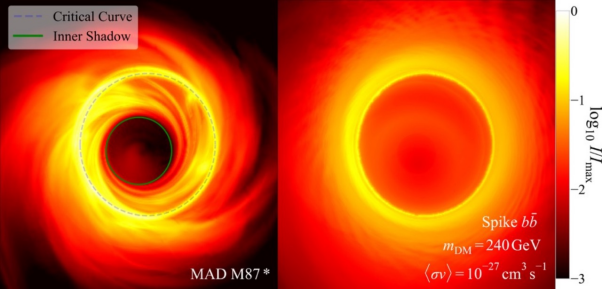
Figure 1: Simulated images of the supermassive black hole M87*: left panel shows radiation from astrophysical plasma; right panel illustrates potential emission from dark matter annihilation.
To ensure robust constraints, the authors developed the most advanced framework to date for modeling electron–positron propagation in the strong gravity and magnetic fields near black holes, grounded in general relativistic magnetohydrodynamic simulations calibrated to current EHT data. Their results rule out wide ranges of previously unexplored dark matter models and establish black hole imaging as a new frontier for fundamental physics. Looking ahead, upgrades to the EHT—particularly improvements in dynamic range—will sharpen sensitivity by probing even darker shadow regions.
https://doi.org/10.1103/yxqg-363n
Dr. Yifan Chen
Center of Gravity,
Niels Bohr Institute
yifan.chen@nanograv.org
Prof. Yosuke Mizuno
Tsung-Dao Lee Institute,
Shanghai Jiao Tong University
mizuno@sjtu.edu.cn
Prof. Ran Ding
School of Physics and Optoelectronics Engineering,
Anhui University
dingran@mail.nankai.edu.cn
Prof. Jing Shu
School of Physics,
Peking University
jshu@pku.edu.cn
Author | Yifan Chen Yosuke Mizuno
Editor | Wenzhuo Meng
Excecutive Editor | Shushu Li