

TDLI RESEARCH ACHIEVEMENTS
来自李政道研究所与法兰克福大学的天体物理学家通过采用广义黑洞描述框架下的先进数值模拟,对这一问题给出了回答:未来的观测极有可能区分出不同理论下的黑洞。
爱因斯坦的广义相对论经受了一个多世纪的严苛检验,但在最极端引力环境(如黑洞附近)中的预测仍基本无法验证。2019年,视界望远镜(EHT)革命性地拍摄到M87星系超大质量黑洞的图像,标志着人类首次直接观测到黑洞阴影,并为检验基础物理理论开辟了前所未有的实验场。
尽管事件视界望远镜(EHT)的观测结果与爱因斯坦对黑洞的预言高度一致,但当前的观测精度尚不足以确证广义相对论是否是对自然界引力最精确的描述,亦无法排除其他引力理论在解释观测数据时可能提供更优的契合。研究者通过先进的成像方法,并基于对黑洞时空结构的通用数学表述,旨在探讨不同引力理论下黑洞的成像特征,以及区分这些理论所需达到的分辨率水平。
来自中国上海和德国法兰克福的科学家作为事件视界望远镜项目成员,如今更进一步解答了一个自然而然的问题:随着新一代望远镜精度提升,两个黑洞图像的差异程度可能达到何种程度?
研究团队采用在曲率时空中运行的最先进三维磁流体力学模拟,并结合辐射传输计算,来研究黑洞附近物质的动态过程并生成等离子体的成像。Akhil Uniyal(李政道研究所研究生、论文第一作者)指出:“通过比较精细的图像度量指标,我们发现当前EHT的分辨率不足以区分不同理论下黑洞成像的微小差异,但随着分辨率的提升,这些差异会系统性增强。未来更高分辨率的望远镜,尤其是空间基项目,有望揭示这些理论间的细微区别。”
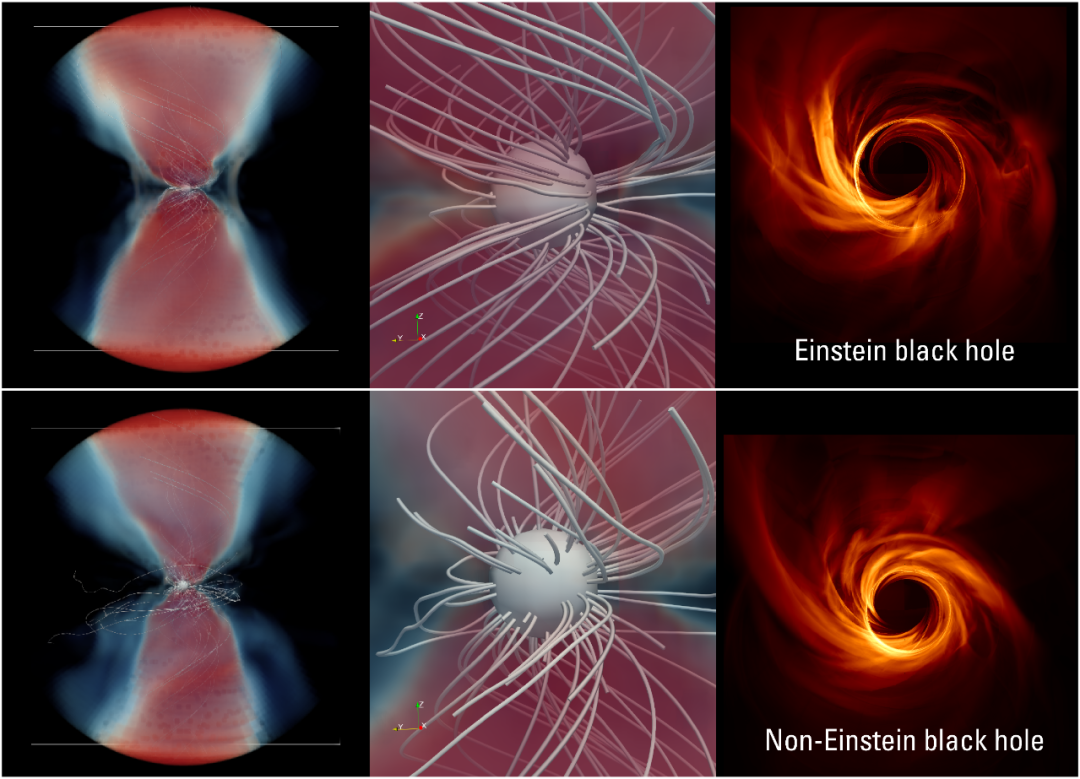
图1:以当前望远镜的解析度而言,不同引力理论预测的黑洞仍呈现极为相似的样貌。未来的望远镜将增大差异,从而能区分爱因斯坦黑洞与其他理论预测的黑洞。
法兰克福大学理论天体物理学Luciano Rezzolla教授指出:"事件视界望远镜合作项目对天体物理学最重要的贡献之一,是将黑洞转化为可验证的‘物体'。在证实M87星系和银河系中存在类似黑洞的物体后,我们现在要探讨的问题是:这些物体是否真的符合爱因斯坦理论预测的黑洞本质?虽然尚未达成目标,但我们已明确解答此问题所需的分辨率标准。”
研究结果表明,要检验替代理论的引力模型,必须具备亚微角秒级的观测分辨率。“这种精度要求已超出现有EHT阵列的能力范围,但它为下一代地基与空间超长基线干涉测量(VLBI)项目指明了明确的目标。实现这一里程碑将使科学家能够超越爱因斯坦引力的范畴,进一步探索引力的本质。”—李政道研究所副教授水野阳介(Yosuke Mizuno)指出。
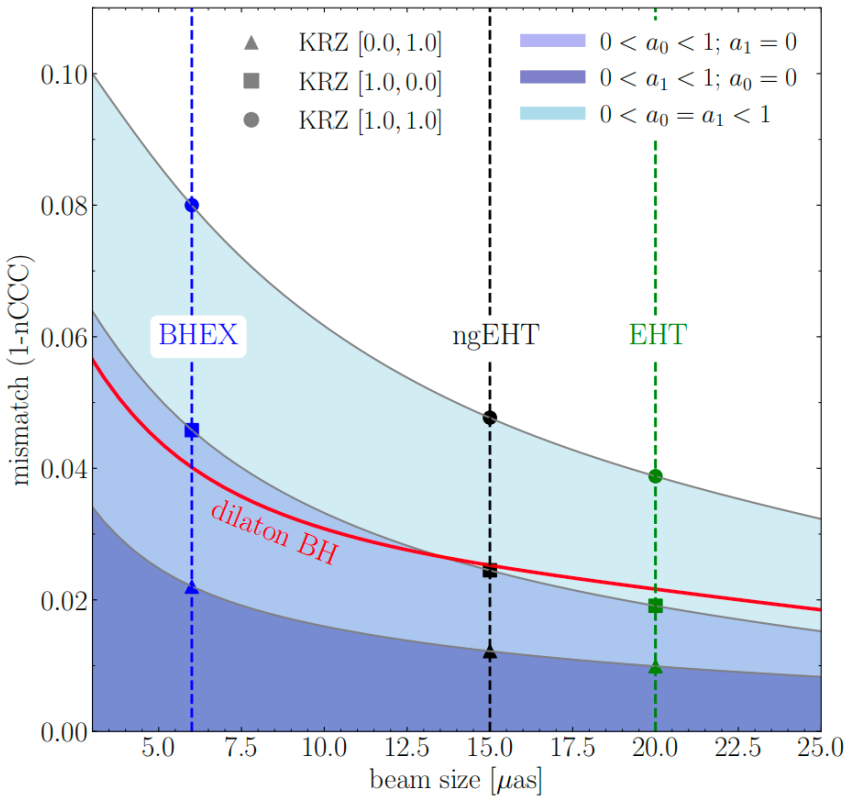
图2: 基于黑洞模拟图像的图像度量(image-metrics)比较。对于不同的观测波束尺寸,给出了归一化互相关系数(1 − nCCC)的结果。当两幅图像完全一致时,失配度为零;当两幅图像完全不同时时,失配度为一。
这项研究的结果已发表于《自然·天文学》。
"The future ability to test theories of gravity with black-hole shadows"
https://www.nature.com/articles/s41550-025-02695-4
文稿 | 水野阳介 秦鹏宇
编辑 | 孟闻卓
责任编辑 | 李姝姝 陆梦珠
Next-generation telescopes will be able to tell black holes apart?
TDLI RESEARCH ACHIEVEMENTS
Astrophysicists at Tsung-Dao Lee Institute and Goethe University Frankfurt answer this question by using advanced simulations with the help of a generalized description of black holes: Future observations are very likely to distinguish the black holes.
Einstein’s general theory of relativity has withstood rigorous testing for more than a century, but its predictions in the most extreme gravitational environments, such as close to black holes, have remained largely untestable. In 2019, the revolutionary Event Horizon Telescope (EHT) images of the supermassive black hole in the M87 galaxy marked the first direct observation of a black hole shadow and opened up an unprecedented laboratory for testing fundamental physics.
Although the EHT observations are perfectly compatible with Einstein’s predictions for black holes, they lack the precision needed to confirm that the general theory of relativity is the most appropriate description or whether alternative theories of gravity provide a more accurate interpretation of the observations. Employing advanced imaging techniques and using a very generic mathematical description of the spacetime of black holes, researchers set out to establish how black holes in different theories would look and what resolution would be needed to tell them apart.
Scientists from Shanghai, China, and Frankfurt, Germany, who are part of the EHT, have now gone a step further and answered a very natural question: How much can two black-hole images differ as the precision will increase with the next-generation telescopes?
The researchers answered this by using the state-of-the-art, three-dimensional
magnetohydrodynamics simulations on curved spacetime to study the dynamics of the matter near a black hole with radiative-transfer calculations to produce images of the emitting plasma. “By comparing the sophisticated image-metrics, we were able to show that the image differences are too small to be captured with the current EHT resolution; however, the differences grow systematically with improved resolution. Hence, future higher-resolution telescopes and space-based projects will be able to pick out the small differences that discriminate black holes in different theories”, says Mr. Akhil Uniyal, graduate student at Tsung-Dao Lee Institute. He is leading author of this study.
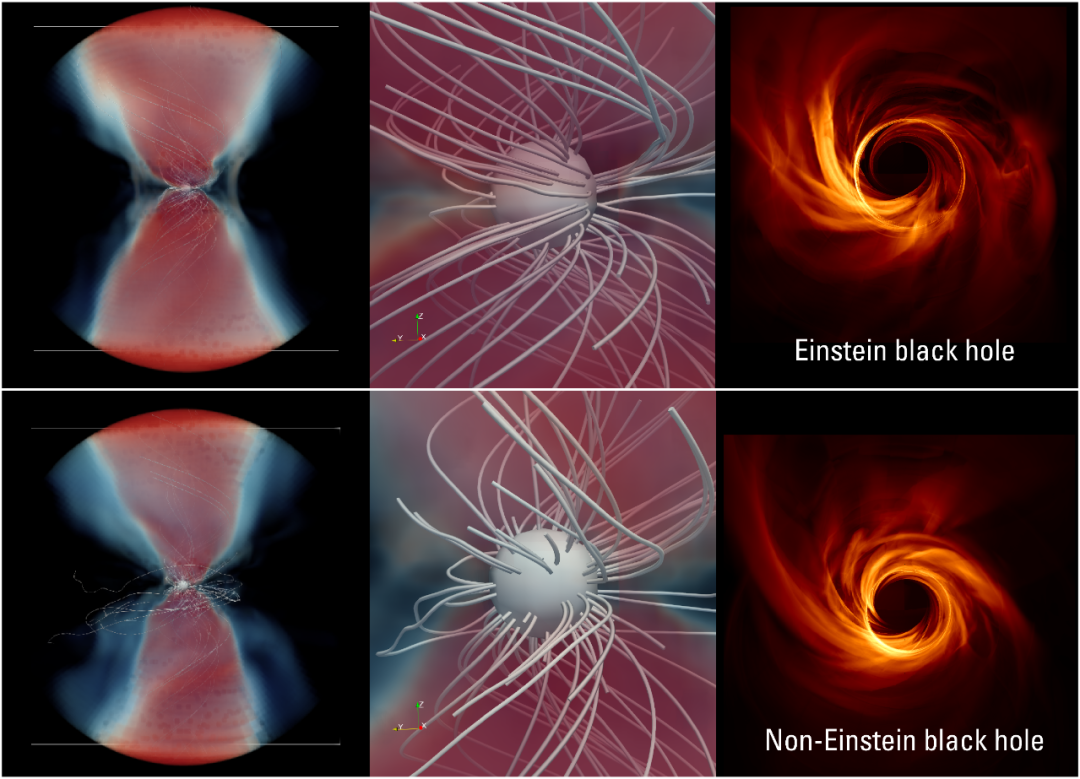
“One of the most important contributions that the EHT Collaboration has made in astrophysics is the transformation of black holes into testable'objects’, remarks Luciano Rezzolla, professor of Theoretical Astrophysics at Goethe University, Frankfurt. “After showing the existence in M87 and in the Milky Way of objects that appear like black holes, the questions we wish to address now are whether these are really the black holes predicted by Einstein’s. We are not there yet, but we now know what is needed in terms of resolution to answer this question”.
The published results demonstrate that sub-micro-arcsecond resolution is essential for probing alternative theories of gravity. “This required precision, which exceeds the capabilities of current EHT array, provides a clear target for projects like next generation ground and space-based very long baseline interferometry missions. Achieving this milestone will enable scientist to look beyond Einstein’s gravity”, mentions Prof. Yosuke Mizuno, associate professor at Tsung-Dao Lee Institute.
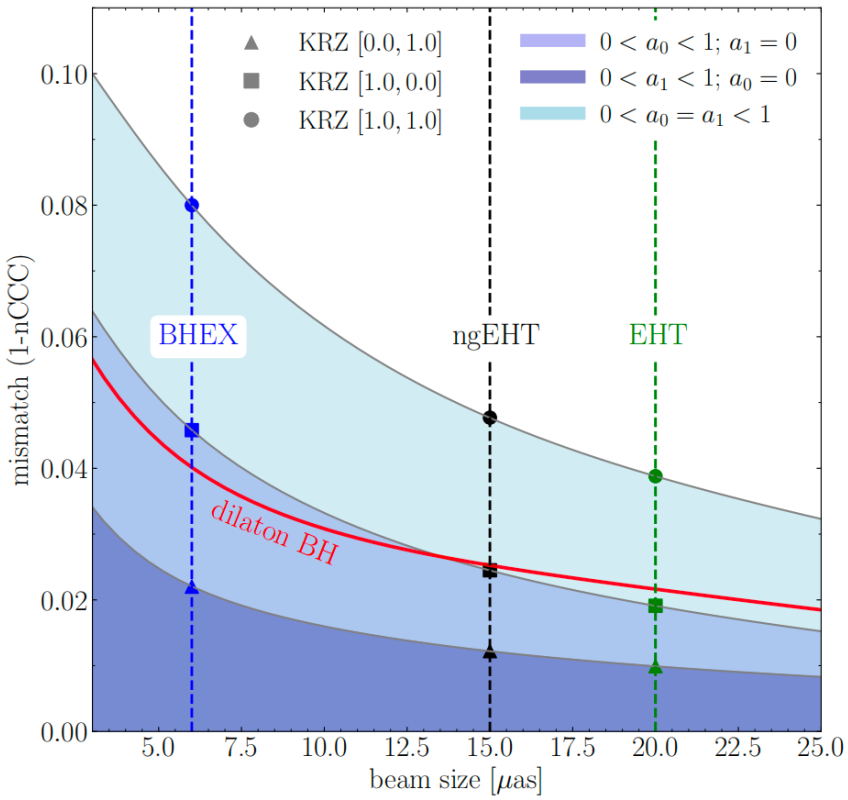
Figure 2: Image-metrics comparison, based on simulated images of black holes. For different observational beam sizes, the normalized cross-correlation coefficient (1-nCCC) is shown. The mismatch is zero when the two images are identical and has the value one for distinct images.
The results of this research have been published in Nature Astronomy.
Article Link
"The future ability to test theories of gravity with black-hole shadows"
https://www.nature.com/articles/s41550-025-02695-4
Contact Information
Akhil Uniyal
email: akhil_uniyal@sjtu.edu.cn
Yosuke Mizuno
email: mizuno@sjtu.edu.cn
Luciano Rezzolla
email: rezolla@itp.uni-frankfurt.de
Links: https://eventhorizontelescope.org
Supported by
该工作得到了国家自然科学基金面上项目 (No. 12273022),国家自然科学基金外籍优秀博士生支持专项 (No. W2442004), 科技部重点研发计划重点专项 (No. 2023YFE0101200)和上海市科学技术委员会2022年度外国专家基础研究项目 (No. 22JC1410600)的资助。
Author | Akhil Uniyal Yosuke Mizuno
Editor | Wenzhuo MengExcecutive Editor | Shushu Li Mengzhu Lu