
TDLI RESEARCH ACHIEVEMENTS
为了充分发挥“中国天眼” FAST中性氢巡天和暗能量光谱仪项目DESI星系光谱巡天两大旗舰项目的突出优势,上海交通大学和英国伦敦大学学院牵头发起了DESI-HI系列合作研究提案。基于该合作框架,上海交通大学、中国科学院国家天文台、上海天文台及英国伦敦大学学院等单位组成的国际合作团队,近期联合利用FAST和DESI的观测数据,对过去45亿年宇宙中性原子氢的演化进行了高精度测量。研究发现,尽管同期宇宙恒星形成活动显著减弱,但作为星系重要气体储备的中性原子氢却仅发生缓慢变化。相关成果以“Weak Evolution of Cosmic Atomic Hydrogen over the Past 4.5 Billion Years”为题发表于国际顶级学术期刊《自然·天文》。
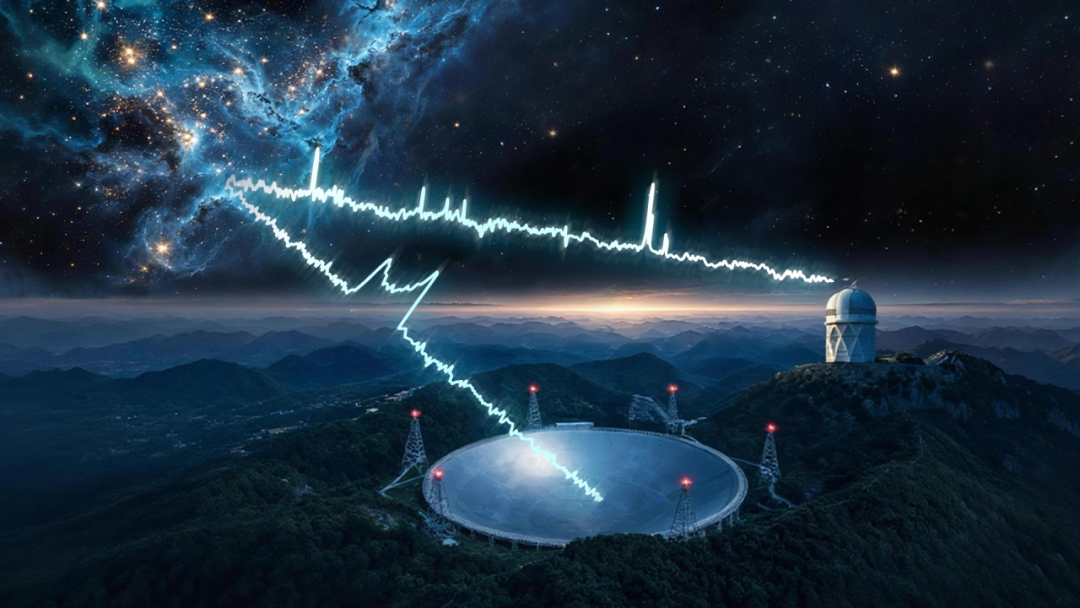
“为什么宇宙越来越难以形成新的恒星?”这是星系形成与演化领域长期关注的核心问题。中性原子氢(中性氢)是形成恒星所依赖的核心物料,是星系中最重要的气体储备之一。此次研究将FAST全天中性氢巡天(FASHI)与暗能量光谱仪项目(DESI)深度融合,利用中性氢谱线叠加技术,把大量单个无法直接探测的微弱信号按星系精确光谱红移对齐,从而从噪声背景中有效叠加出平均中性氢信号。研究最终构建了涵盖约247万个具有可靠光谱红移星系的样本,覆盖天区约12000平方度,以前所未有的统计精度和大样本优势,清晰追溯了宇宙中性氢含量的演化历程。
答案出人意料: 在过去的45亿年间,中性氢储量的降幅远低于恒星形成率的降幅。45亿年前,宇宙恒星形成率约为今天的2.5倍,而同期的中性氢密度仅为今天的1.4倍。换言之,恒星形成活动虽已大幅衰减,中性氢储备却依然相对充裕。这表明,宇宙晚期的恒星形成衰退并非简单的“燃料枯竭”,而是中性原子氢向分子氢、再向恒星转化过程的系统性改变。FAST与DESI的合作研究,为深入理解宇宙晚期的气体循环、恒星形成衰退与星系演化,确立了新的重要观测基准。

【图1】图为宇宙中性氢密度随红移的演化趋势。黑色实心点为此次测量结果,显示过去45亿年宇宙中性氢仅发生缓慢变化,与淡蓝色虚线所代表的恒星形成率显著下降形成鲜明对比。
该研究由上海交通大学杨小虎教授、景益鹏院士团队,中国科学院国家天文台姜鹏研究员团队、上海天文台郭宏研究员团队联合DESI国际团队共同完成。李政道研究所副所长、特聘学者,物理与天文学院特聘教授,暗物质物理全国重点实验室成员杨小虎是DESI-HI系列合作研究提案的发起人之一。李政道研究所助理研究员、JUST团队成员,暗物质物理全国重点实验室成员顾一舟是该论文的共同第一作者。研究同时得到了国家自然科学基金委员会、中国科学院、科学技术部、暗物质物理全国重点实验室等机构的支持。
论文链接
https://doi.org/10.1038/s41550-026-02965-9
FAST × DESI: Star formation faded, but cosmic hydrogen endured
TDLI RESEARCH ACHIEVEMENTS
To fully leverage the strengths of the two flagship facilities—the FAST HI survey (FASHI) and the DESI galaxy spectroscopic survey—SJΤU and UCL jointly initiated the DESI-HI collaborative research proposal. Within this collaborative framework, an international team recently combined observational data from FAST and DESI to conduct high-precision measurements of the evolution of cosmic neutral atomic hydrogen over the past 4.5 billion years. The study reveals that although cosmic star formation activity declined significantly during this period, the neutral atomic hydrogen—an essential gas reservoir for galaxies—exhibited only a gradual decrease. The results have been published in Nature Astronomy under the title "Weak Evolution of Cosmic Atomic Hydrogen over the Past 4.5 Billion Years."

"Why is the Universe becoming increasingly unable to form new stars?" This is a long-standing core question in the field of galaxy formation and evolution. Neutral atomic hydrogen (HI) serves as the fundamental fuel for star formation and represents one of the most important gas reservoirs in galaxies. In this study, the team deeply integrated the FAST All-Sky HI Survey (FASHI) with the Dark Energy Spectroscopic Instrument (DESI) project. By applying spectral stacking—aligning faint galaxy signals according to their precise redshifts—the team extracted the average HI signal from background noise. The resulting sample spans 2.47 million galaxies over 12,000 square degrees, enabling a clear, statistically robust tracing of cosmic neutral hydrogen evolution.
The answer is surprising: over the past 4.5 billion years, the decline in neutral hydrogen mass has been far smaller than that in the star formation rate. About 4.5 billion years ago, the cosmic star formation rate was roughly 2.5 times higher than today, while the neutral hydrogen density at that same epoch was only 1.4 times the present value. In other words, although star formation activity has dropped substantially, the neutral hydrogen reservoir has remained relatively abundant. This suggests that the decline in star formation in the late universe is not simply a matter of "fuel exhaustion," but rather a systematic change in the conversion process from neutral atomic hydrogen to molecular hydrogen, and ultimately to stars. The collaborative study using FAST and DESI has established a new and important observational benchmark for understanding gas cycling, star formation decline, and galaxy evolution in the late universe.
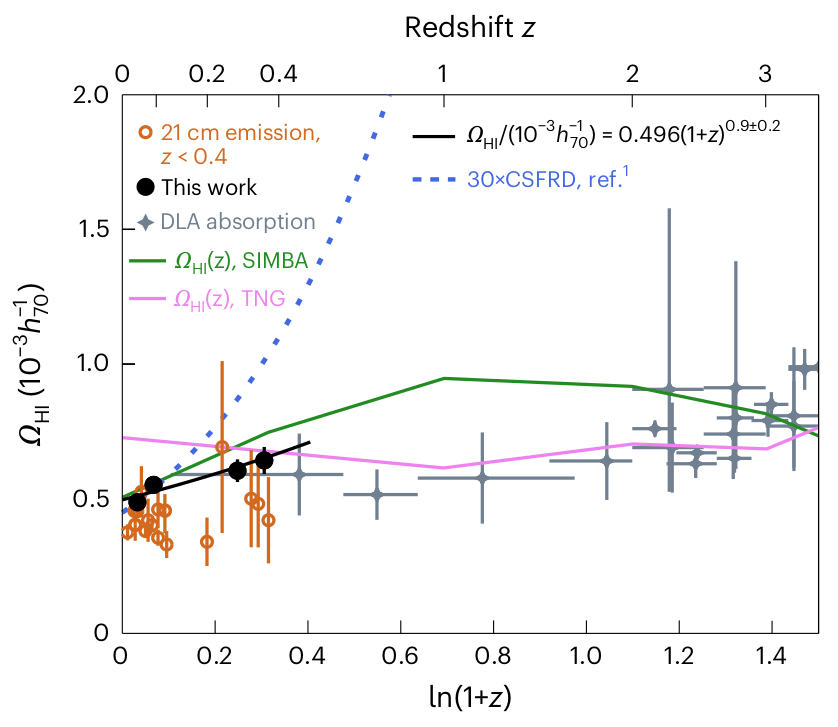
Figure 1 Evolution of cosmic neutral hydrogen density as a function of redshift. Black solid circles represent the measurements from this work, showing that the cosmic neutral hydrogen density has declined only modestly over the past 4.5 billion years, in stark contrast to the significant drop in the star formation rate indicated by the light blue dashed line.
This study represents a collaborative effort involving the teams of Professors Yang Xiaohu and Jing Yipeng from Shanghai Jiao Tong University, the team of Researcher Jiang Peng from the National Astronomical Observatories of China (NAOC) and the team of Researcher Guo Hong from the Shanghai Astronomical Observatory (SHAO), in partnership with the international DESI collaboration. Professor Yang Xiaohu, Deputy Director and Distinguished Fellow of TDLI, professor of PA, and a member of the State Key Laboratory of Dark Matter Physics, is one of the originators of the DESI-HI collaborative research proposal. Dr. Gu Yizhou, an Assistant Scientist of Tsung-Dao Lee Institute, a member of the JUST team, and a member of the State Key Laboratory of Dark Matter Physics, is a co-first author of this paper. This work has also received support by the National Natural Science Foundation of China, the Chinese Academy of Sciences, the Ministry of Science and Technology of China and the State Key Laboratory of Dark Matter Physics.
Paper link
https://doi.org/10.1038/s41550-026-02965-9
文章来源 | 李政道研究所TDLI