
TDLI RESEARCH ACHIEVEMENTS
近日,上海交通大学暗物质物理全国重点实验室、李政道研究所博士后郭新菊与青年学者易龙卿在Advanced Science上发表题为“Helical Electron Beam Micro-Bunching by High-Order Modes in a Micro-Plasma Waveguide”的研究论文,提出了一种产生涡旋结构可调控的高能电子束的新方案。
在紧凑型激光等离子体加速器研究中,如何在小规模实验室条件下产生高能量、高电荷、且具有可控结构的电子束,一直是科学家们追求的目标。近日,李政道研究所易龙卿团队提出并验证了一种基于高功率涡旋激光与微等离子体波导相互作用的电子加速新方案,首次系统展示了高阶波导模对电子束螺旋微束的精确调控能力,电子截止能量可达GeV量级,电荷量超过百nC,束流发散角∼2°。
该研究通过使用圆偏振的Laguerre-Gaussian (LG)激光作为驱动源,注入直径数微米的等离子体波导中。激光与波导壁相互作用,激发出高阶波导模,这些模具有涡旋结构的加速电场,能够从波导壁中拉出高密度电子并对其进行高效加速,如图1 (a)。研究团队通过理论推导与三维粒子模拟发现,驱动激光的拓扑电荷与偏振态共同决定了波导模的方位角阶数,从而控制电子束的螺旋结构。图1 (b)展示了通过调整激光参数成功实现了不同螺旋性电子束,如双螺旋、三螺旋等多种构型,展现了高度可控的微聚束能力。
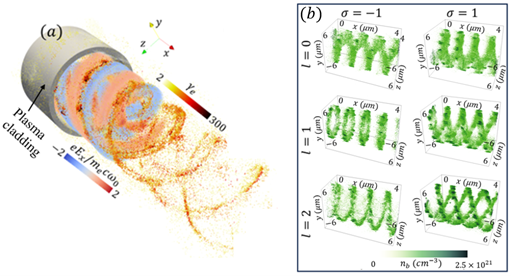
图1. (a) 微通道加速获得的高能电子的三维结构以及加速电场Ex的分布 (b) 具有不同偏振态(σ)和拓扑荷(l)的LG驱动脉冲加速产生的高能电子的三维密度分布。
此外,传统理论认为高阶波导模加速因相速度过快会导致电子迅速失相,从而限制加速能量。然而,该研究发现,电子在加速过程中会发生横向迁移,持续跟随加速相位。这种效应仅在高阶波导模的情况下变得显著,并极大提升了加速能量。图2中显示了在不同时刻高阶模加速下电子的横向迁移现象。
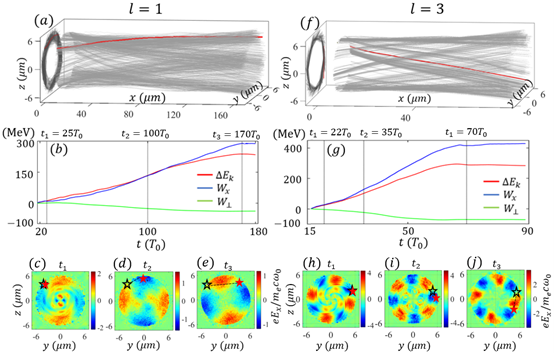
图2 微通道加速中的横向漂移效应:(a) 拓扑荷l=1的右旋圆偏振LG激光加速的高能电子轨迹。(b) 纵向电场做功与横向电场做功以及能量增益(ΔEk)随时间的变化曲线。(c)、(d)、(e)显示了测试电子与所在横截面上的加速场的相对位置,分别对应加速过程的开始、中间和结束时刻。(f-j)与(a-e)相同,但对应拓扑荷l=3的右旋圆偏振LG激光。
该工作为发展桌面式涡旋电子加速器开辟了新路径,所产生的可控涡旋结构高能电子束在超快电子成像、高能物理实验、新型辐射源等领域具有广阔的应用前景。研究得到了国家重点研发计划青年科学家项目与国家自然科学基金的支持。
原文链接
http://doi.org/10.1002/advs.75489
Helical electron beam micro-bunching by high-order modes in a micro-plasma waveguide
TDLI RESEARCH ACHIEVEMENTS
Recently, postdoctoral researcher Xinju Guo and Tenure-track Fellow Longqing Yi from State Key Laboratory of Dark Matter Physics and Tsung-Dao Lee Institute of Shanghai Jiao Tong University, published a research paper titled "Helical Electron Beam Micro-Bunching by High-Order Modes in a Micro-Plasma Waveguide" in Advanced Science, proposing a new scheme for generating high-energy electron beams with tunable vortex structures.
In the study of compact laser plasma accelerators, generating electron beams with high energy, high charge, and controllable structures has long been a goal pursued by scientists. Recently, the team led by Longqing Yi at Tsung-Dao Lee Institute proposed a new electron acceleration scheme based on the interaction between high-power vortex lasers and micro-plasma waveguides. For the first time, they demonstrated the precise control capability of high-order waveguide modes over the helical electron beam micro-bunching. The electron cutoff energy can reach the GeV level, with a high charge exceeding one hundred nC and a beam divergence angle of approximately 2°.
In this study, a circularly polarized Laguerre-Gaussian (LG) laser was used as the driving source and injected into a plasma waveguide with a diameter of a few micrometers. The interaction between the laser and the waveguide walls excites high-order waveguide modes, which extract electrons from the plasma wall and accelerate them to high-energies, as illustrated in Figure 1(a). Through theoretical derivations and three-dimensional particle-in-cell (PIC) simulations, the research team discovered that the topological charge and polarization state of the driving laser jointly determine the azimuthal order of the waveguide modes, thereby controlling the helical structure of the electron beam as shown in Figure 1(b).
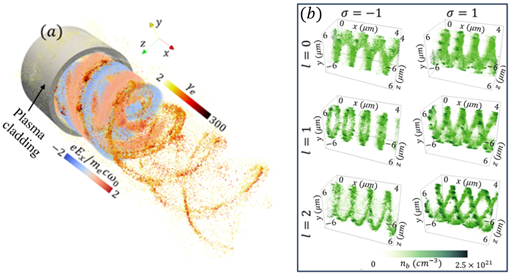
Figure 1. (a) The 3D structure of the accelerated electrons (with colors representing energy) and the accelerating electric field Ex. (b) The 3D density profile of high-energy electrons accelerated by LG laser pulses with various polarizations (σ) and topological charges (l).
Furthermore, traditional theory predicts that acceleration by high-order waveguide modes leads to rapid electron energy saturation due to dephasing caused by substantially superluminal phase velocity. However, this study reveals that electrons undergo transverse migration (Figure 2) during the acceleration process, which mitigates the dephasing effect and allows the helical electron bunch to reach much higher energy.
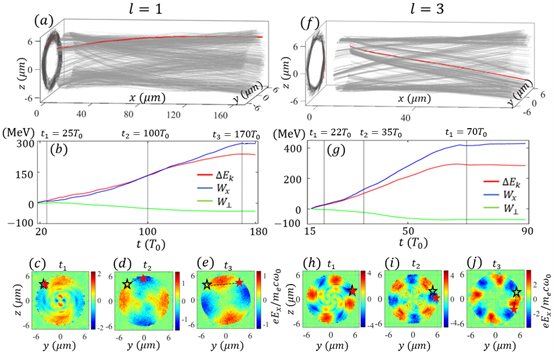
Figure 2. (a) 3D trajectories of accelerated electrons by right-handed circularly polarized LG laser beam with topological charge. (b) The work done by the longitudinal and transverse electric fields, as well as the energy gain as functions of time. The transverse position of a representative electron superposed on the local Ex field at (c) the beginning, (d) the middle, and (e) the end of acceleration process. (f-j) are the same as (a-e) but for right-handed circularly polarized LG driver with l = 3
This work opens a new pathway for the development of desktop helical electron accelerators, and the generated controllable helical high-energy electron beams hold broad application prospects in fields such as ultrafast electron imaging, high-energy physics experiments, and novel radiation sources. This research was supported by the National Key R&D Program for Young Scientists and the National Natural Science Foundation of China.
Article Link
http://doi.org/10.1002/advs.75489
文章来源 | 李政道研究所TDLI