11月20日,2025浦江创新论坛物理与天文分论坛在李政道研究所举办。本次论坛由上海市科学技术委员会和浦东新区人民政府共同指导,李政道研究所、上海交通大学物理与天文学院和暗物质物理全国重点实验室联合承办,以“致敬李政道先生——当极大遇到极小”为主题,围绕物理与天文科学前沿展开深度探讨,旨在传承科学精神,激发创新思维,促进交叉融合。来自国内外相关院校和科研机构的专家学者、校内外兄弟单位及李政道研究所师生齐聚一堂,共同探索宇宙奥秘。
上海市科学技术委员会副主任屈炜,上海市浦东新区科技与经济委员会主任汪潇,中国科学院院士、上海交通大学原校长、李政道研究所所长张杰,上海交通大学党委常委、副校长管海兵,以及来自苏黎世联邦理工学院和洛桑联邦理工学院教授Gabriel Aeppli,中国科学院院士、上海交通大学讲席教授丁洪,英国杜伦大学讲席教授Carlos Frenk,美国匹兹堡大学讲席教授韩涛,上海交通大学讲席教授何小刚,意大利特里埃斯特天文台教授Stavro Ivanovski,美国马里兰大学教授、上海交通大学讲席教授季向东,上海交通大学讲席教授赖东,美国加利福尼亚大学圣克鲁斯分校教授林潮,上海交通大学讲席教授Michael Ramsey-Musolf,中国科学院院士、中国科学技术大学教授潘建伟,荷兰乌得勒支大学教授Cristiane Morais Smith,意大利米兰大学教授Alessandro Vicini等专家学者出席论坛。论坛开幕式由上海交通大学李政道研究所副所长、鸿文特聘学者刘江来主持。
开场致辞:共话创新使命

张杰致开幕辞
张杰为论坛致开幕辞。他表示,本次论坛以“致敬李政道先生——当极大遇到极小”为主题,是对李先生科学精神的时代传承。李政道先生提出的“极大宇宙”与“极小粒子”的深刻关联,是推动基础物理学发展的核心动力,也是李政道研究所始终坚守的科研使命。在即将迎来李政道先生百岁诞辰之际,这场学术盛会既是对大师科学精神的崇高致敬,也是对青年一代的深切期许,激励他们勇闯认知边疆,共同绘制人类探索未知的新蓝图。

管海兵致辞
管海兵在致辞中指出,李政道研究所作为学校重点建设的前沿研究机构,已快速发展为全球物理与天文领域瞩目的学术高地,是推动学校实现学科跨越式发展的核心引擎。他强调,李政道研究所首次承办浦江创新论坛物理与天文分论坛,标志着其在基础研究领域的学术实力与国际声誉获得广泛认可,也彰显了上海主动融入全球创新网络的引领担当。他期待本次论坛凝聚全球智慧,激发创新思维,为推动我国基础科学研究高质量发展注入新动能。

屈炜致辞
屈炜在致辞中强调,上海正深入贯彻落实国家基础研究十年规划,持续强化科技创新策源功能,加快建设具有全球影响力的科技创新中心。他指出,李政道研究所作为基础研究领域的战略科技力量,通过构建“理论-实验-技术”全链条创新体系,已成为上海服务国家科技自立自强的重要支撑。未来,上海将持续深化基础研究系统布局,凝聚全球顶尖智慧,在物理与天文等前沿领域力争实现更多引领性突破,为构建全球科技创新网络贡献上海智慧。

汪潇致辞
汪潇在致辞中表示,浦东新区作为上海科创中心的核心承载区,始终将基础研究作为高质量发展的战略基石。他指出,李政道研究所扎根浦东以来,已成为汇聚全球顶尖智慧、推动原始创新的重要科研高地,为区域创新生态注入强劲动力。未来,浦东将持续强化政策与资源保障,全力支持李政道研究所开展原创性引领性研究,推动实现更多“从0到1”的突破,为国家基础研究事业发展贡献浦东力量。

刘江来主持开幕式
主旨报告:聚焦前沿探索
丁洪、赖东、何小刚主持主旨报告环节
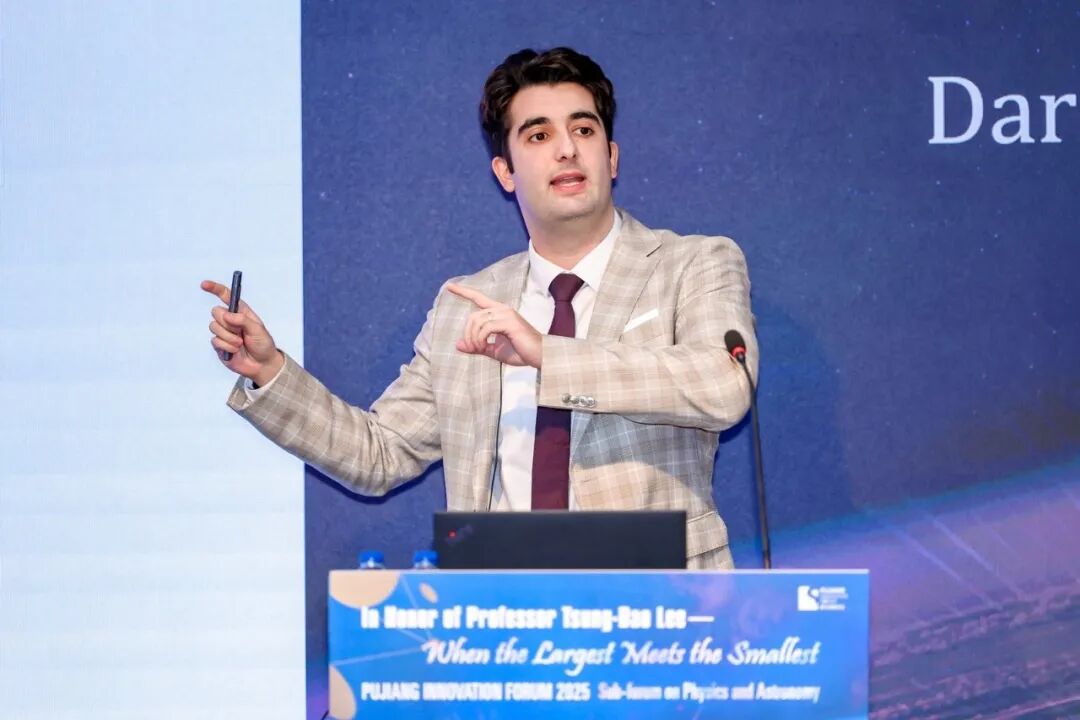
在主旨报告中,多位国际知名学者分享了物理与天文领域的前沿进展。在粒子物理与超越标准模型探索方面,韩涛系统阐述了如何利用高能对撞机数据,通过自旋态等构建量子态并进行量子层析成像。Alessandro Vicini介绍了标准模型电弱部分的精确测试现状,强调了高精度实验的挑战。多位学者提出了超越标准模型的新物理图景:Michael Ramsey-Musolf认为早期宇宙的“宇宙冷凝”过程或能解释物质-反物质不对称性;Jason Evans分析了超轻玻色型暗物质的玻色增强效应,为探测暗光子提供了新途径。在宇宙学与天体物理学方面,Carlos Frenk总结了超级计算机模拟在重现宇宙演化上的惊人成就,同时指出暗物质、暗能量本质等问题依然悬而未决。在星系尺度上,林潮揭示了活动星系核中恒星质量黑洞与主序星合并、并激发强烈引力波,从而促进超大质量黑洞增长的过程。在量子信息与新奇物态研究方面,潘建伟全面展示了中国在量子通信领域的系列突破,并展望了全球量子网络的蓝图。在新物态探索方面,Vadim Grinenko报告了在铁基超导材料中发现电子四重态凝聚的证据;Cristiane Morais Smith则揭示了在分形维度中电子光子的独特行为及分形本身诱导的拓扑特性。此外,报告也体现了物理技术在多学科的广泛应用。Gabriel Aeppli介绍了非破坏性的X射线叠层衍射技术,该技术能以纳米级分辨率进行三维成像,在集成电路检测与脑科学中潜力巨大。在行星科学方面,Stavro Ivanovski介绍了综合行星大气、磁场等参数构建的宜居性模型;Darius Modirrousta-Galian则提出了一个统一流体动力学与分子运动论的大气逃逸新框架。这些成果充分展现了从微观粒子到宏观宇宙,从基础理论到前沿技术等交叉领域所取得的重要进展。
主旨报告人

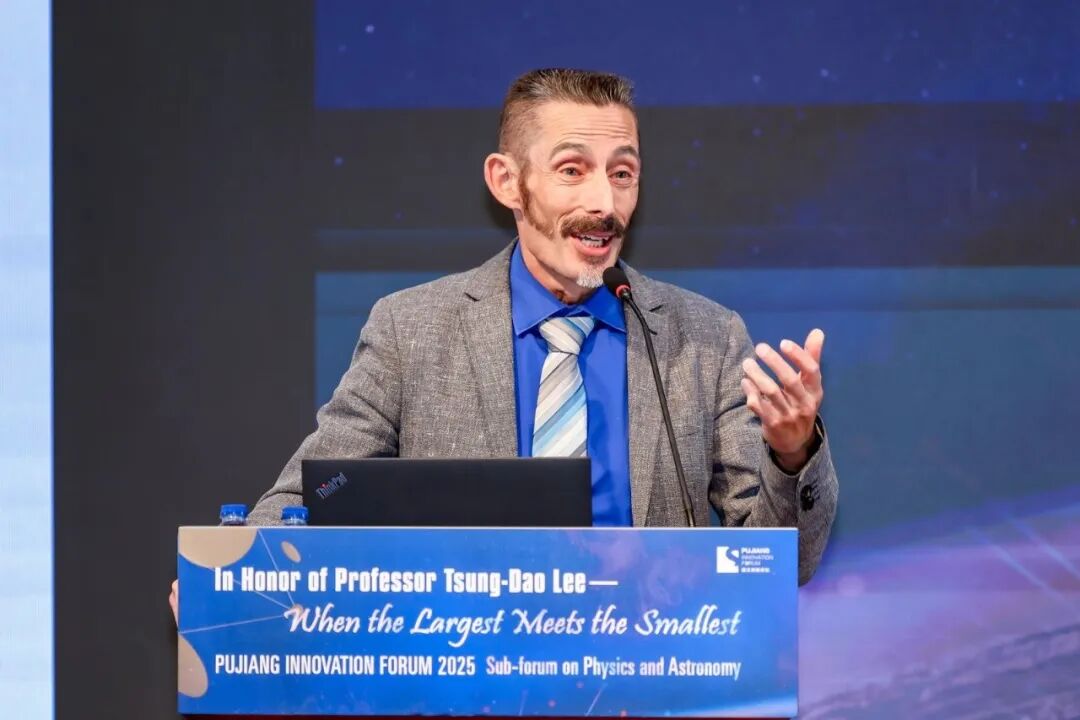
韩涛
Michael Ramsey-Musolf
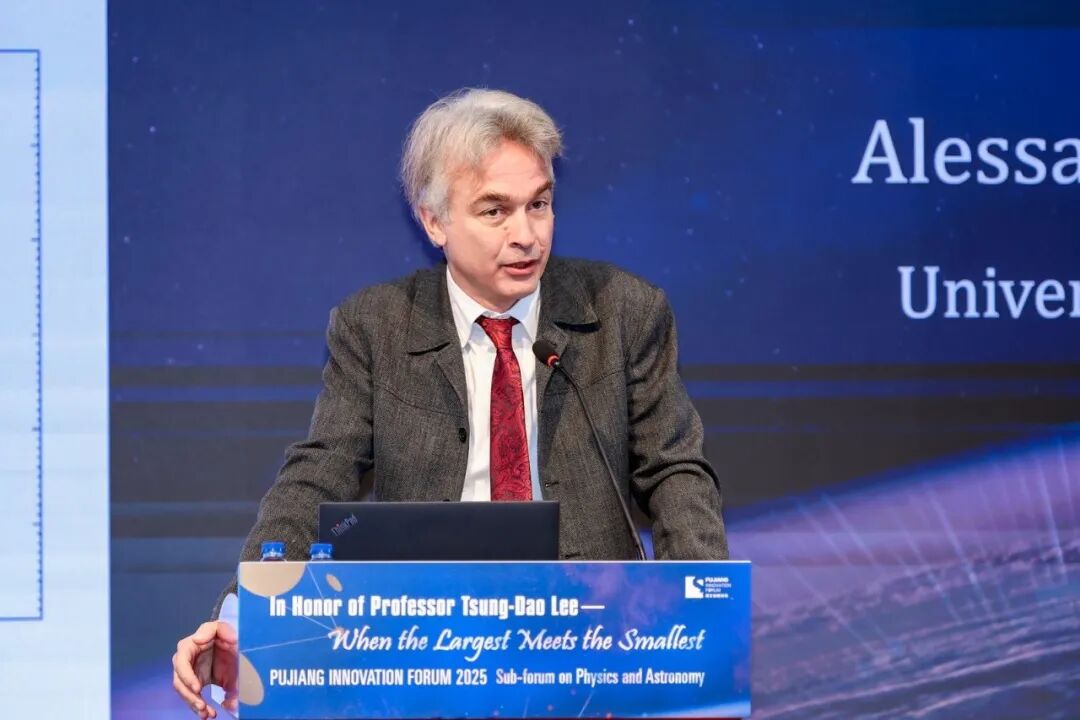

Alessandro Vicini
Jason Evans
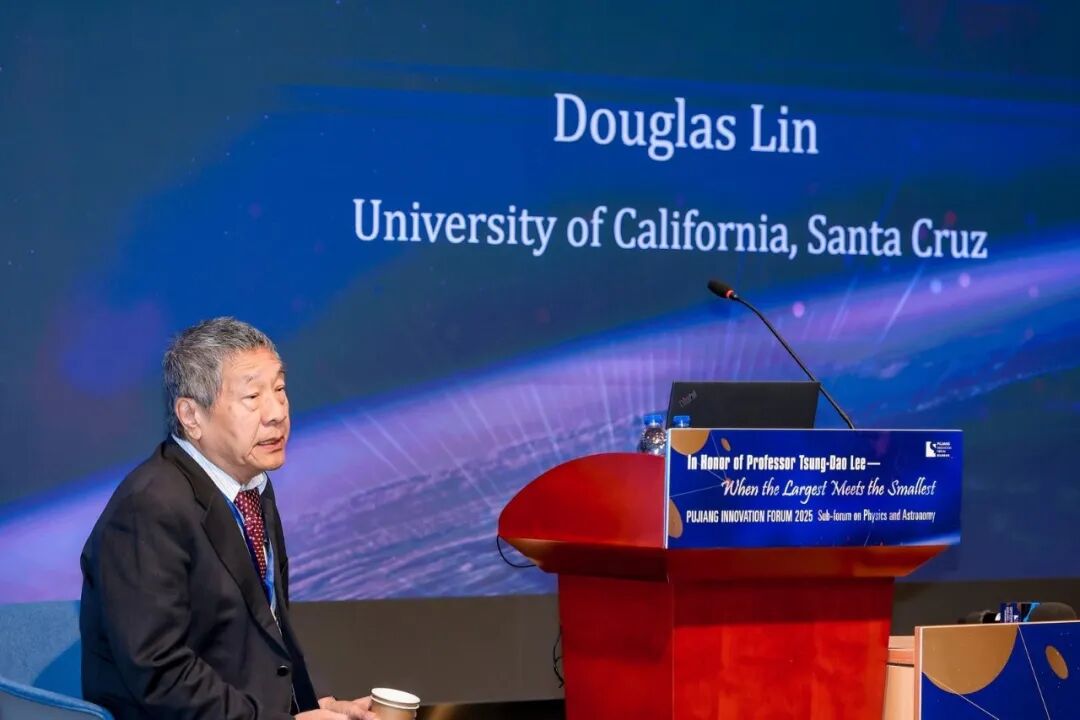

林潮
Carlos Frenk
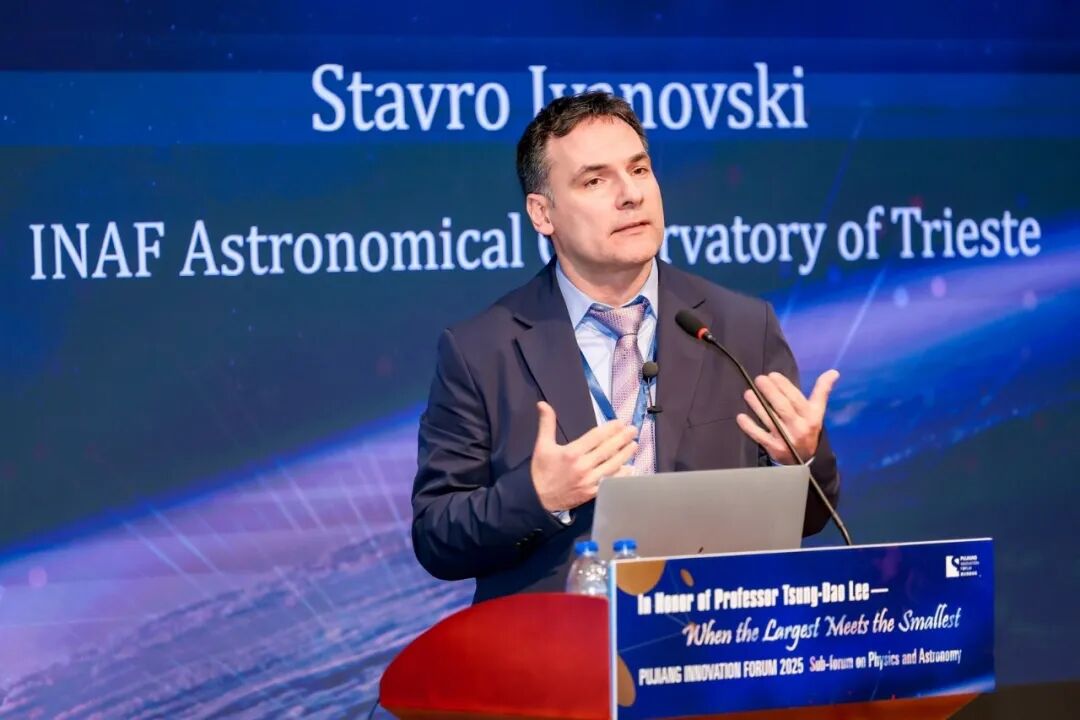
Stavro Ivanovski
Darius Modirrousta-Galian
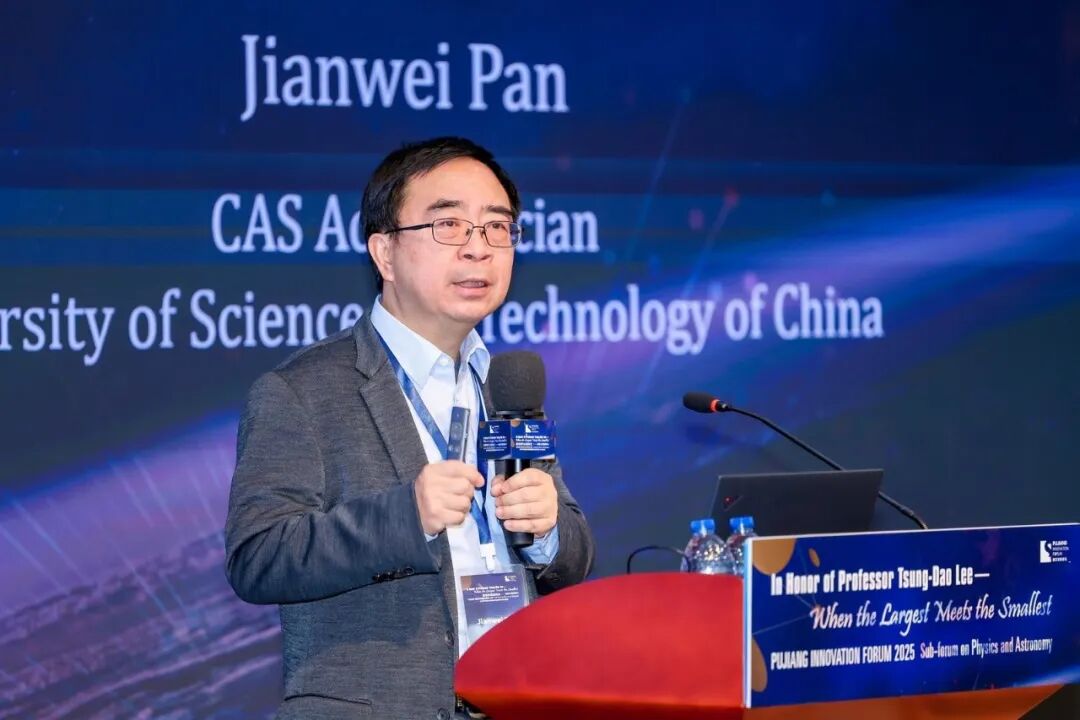
潘建伟
Gabriel Aeppli


Cristiane de Morais Smith
Vadim Grinenko
圆桌对话:碰撞智慧火花

圆桌对话
圆桌对话环节由Michael Ramsey-Musolf担任主持,Carlos Frenk、韩涛、赖东和Cristiane Morais Smith四位科学家担任嘉宾,围绕国际科学合作、物理与天文学的核心前沿及青年学者成长等主题展开深入讨论。首先,多位嘉宾回顾了李政道先生在推动中美科学交流与支持青年人才培养方面的深远贡献,并强调在复杂国际形势下,科学家需秉持开放包容的协作精神,构建科研共同体。在学术探讨方面,嘉宾们指出,粒子物理、宇宙学、暗物质及量子信息等领域面临的核心科学挑战,是推动基础科学实现革命性突破的重要方向与根本动力。针对青年科技人才培育,鼓励青年学者坚守科学初心,在理想与现实间寻求动态平衡。嘉宾们特别指出,科研突破往往孕育于交叉融合之中,青年人才应积极拥抱学科交叉所带来的新机遇,以开拓性思维探索未知领域,以持之以恒的追求面对基础科学研究中的挑战,共同推动物理与天文学科向新的高度迈进。
本次论坛的成功举办,不仅为与会人员搭建了高水平的交流平台,有效激发了原始创新活力,更显著提升了李政道研究所与浦江创新论坛品牌活动的国际影响力,为我国实现高水平科技自立自强提供了坚实支撑。
2025 Pujiang Innovation Forum
Physics and Astronomy Sub-Forum
Held at Tsung-Dao Lee Institute
On November 20, the 2025 Pujiang Innovation Forum Physics and Astronomy Sub-Forum was successfully convened at Tsung-Dao Lee Institute (TDLI). Guided by the Shanghai Municipal Science and Technology Commission and the People's Government of Pudong New Area, and jointly organized by TDLI, the School of Physics and Astronomy at Shanghai Jiao Tong University (SJTU), and the State Key Laboratory of Dark Matter Physics, the forum was themed "In Honor of Prof. Tsung-Dao Lee – When the Largest Meets the Smallest." It facilitated in-depth discussions on cutting-edge topics in physics and astronomy, aiming to carry forward the scientific spirit, stimulate innovative thinking, and promote interdisciplinary integration. Participants including experts and scholars from domestic and international institutions, representatives from collaborating organizations, and faculty and students of TDLI, gathered to explore the mysteries of the universe together.
Distinguished attendees included Wei Qu, Deputy Director of the Shanghai Municipal Science and Technology Commission; Xiao Wang, Director of the Science, Technology and Economy Commission of Pudong New District; Jie Zhang, CAS Academician , former President of SJTU and Director of TDLI; Haibing Guan, Member of the Standing Committee of the CPC SJTU Committee and Vice President of SJTU; as well as renowned scholars such as Professor Gabriel Aeppli from ETH Zürich and EPFL; CAS Academician and SJTU Chair Professor Ding Hong; Professor Carlos Frenk at Durham University, UK; Professor Tao Han at the University of Pittsburgh, USA; Professor Xiaogang He at SJTU; Professor Stavro Ivanovski from the Trieste Astronomical Observatory, Italy; Professor Xiangdong Ji at the University of Maryland and SJTU; Professor Dong Lai at SJTU; Professor Douglas Lin from the University of California, Santa Cruz; Professor Michael Ramsey-Musolf at SJTU; CAS Academician and Professor Pan Jianwei from the University of Science and Technology of China; Professor Cristiane Morais Smith from Utrecht University, Netherlands; and Professor Alessandro Vicini from the University of Milan, Italy. The opening ceremony was hosted by Professor Jianglai Liu, Deputy Director of TDLI and Hongwen Distinguished Scholar at SJTU.
Opening Ceremony:
A Shared Mission for Innovation

Opening Remarks by Jie Zhang
Jie Zhang delivered the opening remarks. He stated that the forum's theme, "In Honor of Prof. Tsung-Dao Lee – When the Largest Meets the Smallest," represents a contemporary inheritance of Prof. Lee's scientific spirit. The profound connection between the "largest" cosmos and the "smallest" particles, as highlighted by Prof. Lee, remains a core driver advancing fundamental physics and a central research mission steadfastly upheld by TDLI.
As the centennial of Prof. Lee's birth approaches, this academic gathering serves as both a profound tribute to the master's scientific legacy and deep encouragement for the younger generation, inspiring them to courageously push the boundaries of knowledge and collectively chart a new blueprint for humanity's exploration of the unknown.
Speech by Haibing Guan
Haibing Guan pointed out that TDLI, as a priority frontier research institute at SJTU, has rapidly developed into a globally recognized academic highland in physics and astronomy, serving as a core engine driving the university's leapfrog development in these disciplines.
He emphasized that TDLI hosting the Pujiang Innovation Forum Physics and Astronomy Sub-Forum for the first time signifies broad recognition of its academic strength and international reputation in fundamental research, also demonstrating Shanghai's leadership and commitment in proactively integrating into the global innovation network.
He expressed his hope that the forum would pool global wisdom, spark innovative ideas, and inject new momentum into the high-quality development of China's basic scientific research.
Speech by Wei Qu
Wei Qu emphasized that Shanghai is thoroughly implementing the national long-term plan for basic research, continuously strengthening its role as a source of scientific and technological innovation, and accelerating the construction of a globally influential science and technology innovation center.
He noted that TDLI, as a strategic force in basic research, has become a crucial pillar for Shanghai in serving national sci-tech self-reliance through building a full-chain innovation system integrating "theory-experiment-technology."
He stated that Shanghai will continue to deepen the systematic layout of basic research, gather top global intellect, and strive for more groundbreaking achievements in frontier fields like physics and astronomy, contributing Shanghai's wisdom to the global sci-tech innovation network.

Speech by Xiao Wang
Xiao Wang stated that Pudong New Area, as the core hub of Shanghai's sci-tech innovation center, consistently treats basic research as the strategic cornerstone for high-quality development.
He noted that since its establishment in Pudong, TDLI has become a vital research highland attracting global top talent and driving original innovation, injecting strong momentum into the regional innovation ecosystem.
He affirmed Pudong's continued commitment to enhancing policy and resource support, fully backing TDLI in conducting pioneering and leading research, achieving more "zero-to-one" breakthroughs, and contributing Pudong's strength to the nation's basic research endeavors.

Hosted by Jianglai Liu
Keynote Talks:
Focusing on Frontier Exploration
Keynote talks hosted
by Hong Ding, Dong Lai & Xiaogang He
During the keynote talks, guest speakers shared cutting-edge advancements across physics and astronomy.
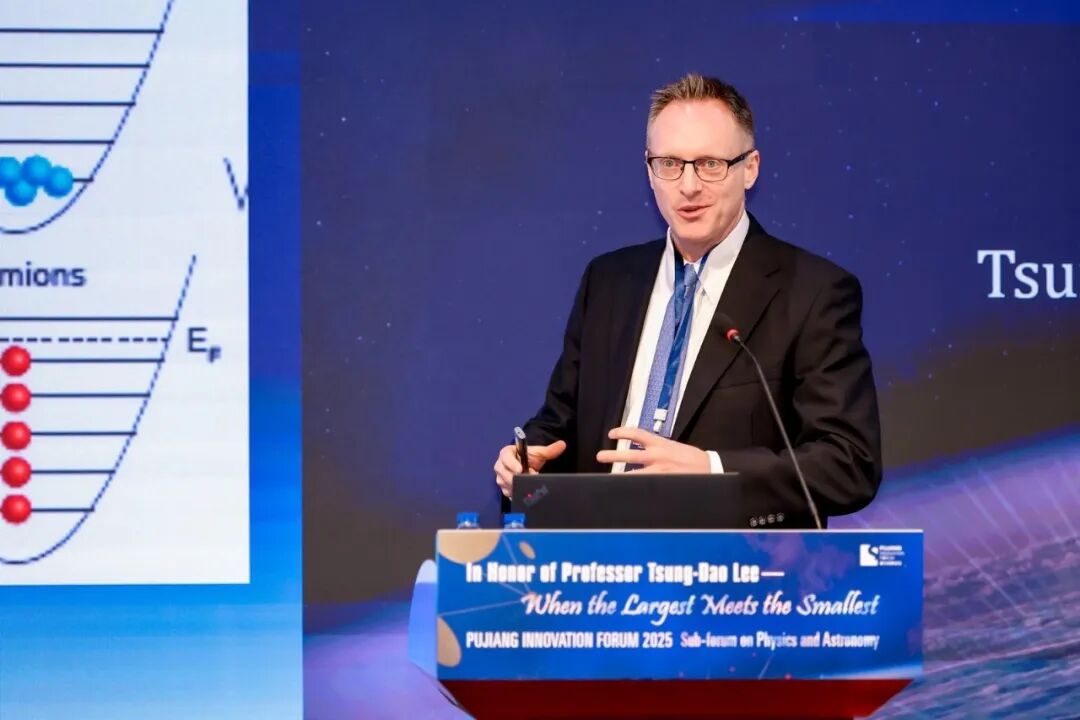
In particle physics and searches beyond the Standard Model (BSM), Han Tao elaborated on constructing quantum states using spin states etc., from high-energy collider data and performing quantum tomography. Alessandro Vicini detailed the status of precision tests for the electroweak sector of the Standard Model, highlighting challenges for high-precision experiments. Several scholars proposed new BSM scenarios: Michael Ramsey-Musolf suggested that a "cosmic condensation" process in the early universe might explain matter-antimatter asymmetry; Jason Evans analyzed the bosonic enhancement effect for ultralight bosonic dark matter, offering new avenues for detecting dark photons.
In cosmology and astrophysics, Carlos Frenk summarized the remarkable success of supercomputer simulations in replicating cosmic evolution, while noting unresolved questions like the nature of dark matter and dark energy. On galactic scales, Douglas Lin revealed the process where stellar-mass black holes merge with main-sequence stars in Active Galactic Nuclei, triggering strong gravitational waves and facilitating supermassive black hole growth.
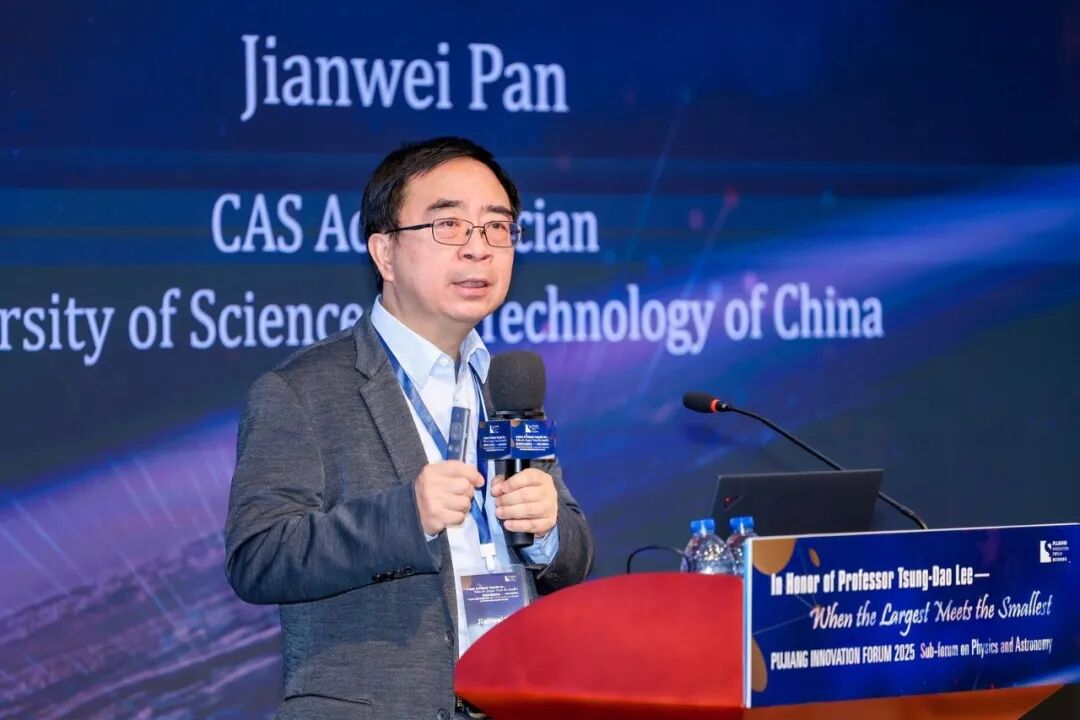
In quantum information and novel states of matter, Pan Jianwei comprehensively showcased China's breakthroughs in quantum communicationand outlined the vision for a global quantum network. Exploring new states of matter, Vadim Grinenko reported evidence for electronic quadruplet condensation in iron-based superconductors, while Cristiane Morais Smith uncovered unique electron-photon behaviors in fractal dimensions and topology induced by the fractal geometry itself.
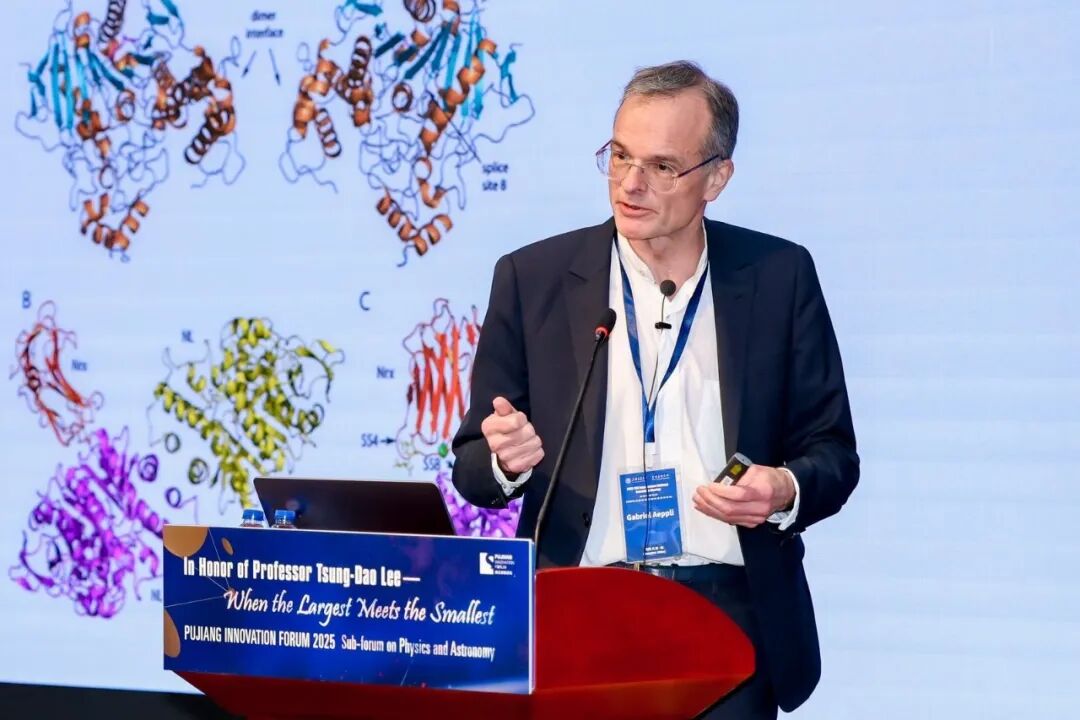
Furthermore, reports highlighted interdisciplinary applications of physical techniques. Gabriel Aeppli introduced non-destructive X-ray ptychography, capable of 3D imaging with nanometer resolution, holding great potential for integrated circuit inspection and brain science.
In planetary science, Stavro Ivanovski discussed habitability models integrating planetary atmosphere, magnetic field parameters, etc.; Darius Modirrousta-Galian proposed a new unified framework for atmospheric escape combining hydrodynamics and molecular kinetics.
These reports fully demonstrated significant progress spanning interdisciplinary fields from microscopic particles to the macroscopic cosmos, and from fundamental theory to cutting-edge technology.
Keynote Talkers


Tao Han
Michael Ramsey-Musolf

Alessandro Vicini
Jason Evans


Douglas Lin
Carlos Frenk


Stavro Ivanovski
Darius Modirrousta-Galian

Jianwei Pan
Gabriel Aeppli


Cristiane de Morais Smith
Vadim Grinenko
Roundtable Discussion:
Igniting Intellectual Sparks

Roundtable Discussion
The roundtable discussion, moderated by Michael Ramsey-Musolf, featured four panelists: Carlos Frenk, Tao Han, Dong Lai, and Cristiane Morais Smith.
The discussion delved into themes of international scientific collaboration, core frontiers in physics and astronomy, and the growth of young scholars. Panelists first reflected on Prof. Tsung-Dao Lee's profound contributions to promoting Sino-US scientific exchange and supporting young talent, emphasizing the need for scientists to uphold an open and inclusive spirit of collaboration and build a scientific community, especially amidst complex international landscapes.
Academically, the guests identified core scientific challenges in particle physics, cosmology, dark matter, and quantum information as pivotal directions and fundamental drivers for revolutionary breakthroughs in basic science.
Regarding nurturing young scientific talent, they encouraged early-career researchers to stay true to their scientific initial aspirations, seeking a dynamic balance between ideal and reality.
The panelists particularly noted that research breakthroughs often emerge from interdisciplinary integration, urging young talents to actively embrace opportunities arising from cross-disciplinary research, explore the unknown with pioneering thinking, persevere through the challenges inherent in basic research, and collectively propel physics and astronomy to new heights.
The successful convening of this Forum has not only provided a high-level platform for participants to exchange ideas and effectively stimulated original innovation, but also significantly enhanced the international influence both of Tsung-Dao Lee Institute and the Pujiang Innovation Forum brand, providing solid support for China's pursuit of high-level self-reliance and strength in science and technology.
文稿来源 | 李政道研究所
